
Shopify | An Ecommerce Backbone
The hidden 40% ROCE company growing 30%

Disclaimer: The content does not constitute investment advice or any other sort of advice. Nothing in this post should be construed as a personal recommendation or advice to buy, sell, or hold any investment or security. Full Disclaimer can be accessed here.Hi!
I’m Armin, a former PE and HF investor who left the industry to find more compelling investment ideas.
I run a concentrated portfolio of fewer than ten holdings. Specialized in asymmetric value investments, I back my research with data-driven insights.
What interests me are easy-to-understand businesses with predictable cashflows bought at valuations that limit downside but offer multibagger upside.
Using this approach, I grew my portfolio by +142% vs. the S&P 500’s return of 49% - an outperformance of 93ppts.
These posts document my investment research to grow my portfolio which represents >80% of my net worth.
In 2004, Tobias Lütke tried to sell snowboards online and hated every piece of software available to build the store. So he built his own. That decision, a frustrated merchant refusing to pay for tools that weren’t good enough, is the reason Shopify exists. Twenty years later, it’s also the exact bet the market is worried merchants can now make against Shopify itself.
The bet paid off for Lütke. Shopify now delivers 5% of global ecommerce GMV, powers millions of merchants across more than 175 countries, and grew revenue more than 30% last year. But since November, the stock has fallen roughly 30% from its all-time high, hit by a wave of AI fears, chief among them, that AI coding tools now let a merchant do what Lütke did in 2004: build a store on its own.
Trading at an EV/Sales of 10x does not scream cheap, but that’s on the cheaper end of Shopify’s valuation over the last 10 years, and not excessive for a company exceeding the Rule of 40 (Revenue growth + EBITDA margin exceeding 40%).
Let’s unpack the opportunity of Shopify, a category-defining market leader and compounder.
Business Overview - How SHOP Makes Money
Shopify is an all-in-one platform for commerce. Best known for website building with seamless online shop integration, its offering is vast and deeply engrained.
Shopify provides an integrated back-end system to streamline operations, from managing inventory, transaction management, shipping workflows with shipping labels and in-store Point-Of-Sale (POS) systems to building relationships with buyers. With a full integration to Google, Amazon, AI (ChatGPT, Copilot, Gemini) and Social Media (Instagram, TikTok, Pinterest) Shopify became the go-to solution not only for new brands but also established enterprises such as L’Oreal, Miele, Alo, Nestlé, Heinz, Mattel and Balmain (and many more).
To put it into Shopify’s words:
Sell everywhere people shop. Online and in person. Across AI and on social. Locally and globally.
Your favorite brands, all powered by Shopify.
Here’s how Shopify makes money…
Subscription Solutions
Subscriptions are the service most people associate with Shopify. Customers who register a domain name, create a website or, for (partially) physical businesses, want POS hardware and software get access to Shopify’s solutions via fixed monthly plans. However, prices vary based on the selected tier.
Monthly packages start at EUR 36 (Basic) and increase to more than 2,000 (Plus). Basic is a somewhat slimmer offering compared to Plus, but it still has the full AI suite, payment capabilities as well as hosting, marketing and global sales features. More expensive packages offer better payment rates and higher limits for e.g. inventory location management, staff accounts, support; but the Basic offering has the full functionality required to run a business.
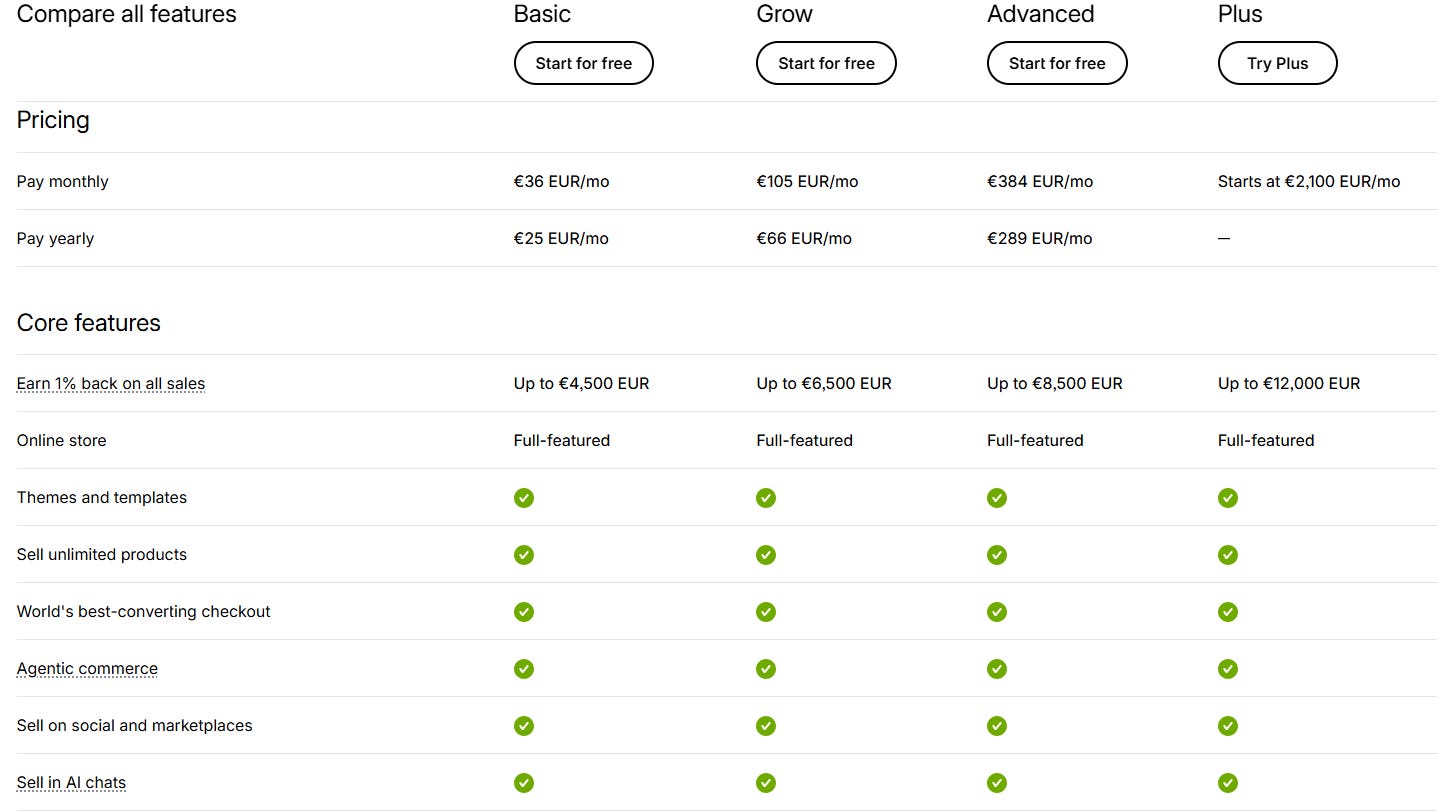
That’s the appeal for new founders: Pay a small fee and get close to the capabilities of a large merchant. With that, Shopify is highly successful in attracting and locking-in new entrepreneurs.
Merchant Solutions
Augmenting subscriptions in order to address a broad array of functionality merchants require, merchant solutions include accepting payments, securing working capital and shipping. These are usage-based fees.
While subscription solutions offer access to payments at varying rates, the revenue generated from accepted payments is categorized as merchant solutions. If a merchant doubles its revenue, Shopify doubles its revenue.
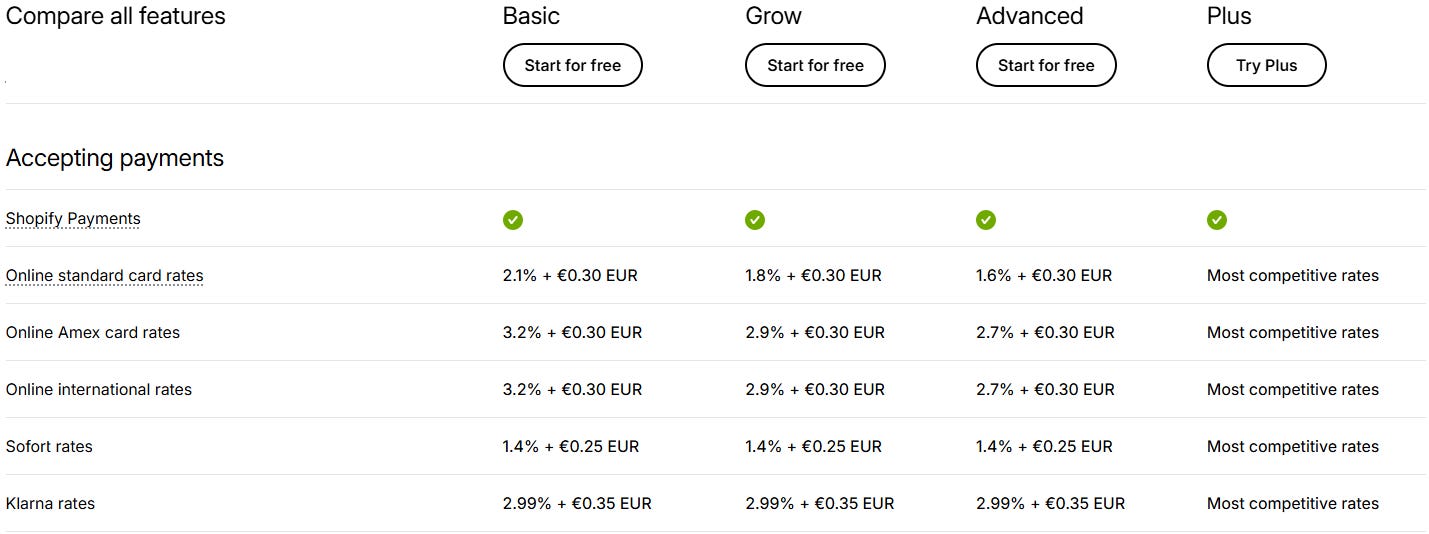
While payment processing fees and currency conversion fees are an integral part of the business, merchant solutions also encompasses lending services, referral fees from partners, the sale of shipping labels, the sale of Point-of-Sale ("POS") hardware, advertising on the Shopify App Store and Shop Campaigns.
Shopify Capital is the financing and lending solution for merchants. Offering sales-based repayment loans — a funding method where businesses repay lenders with a percentage of ongoing revenue until a predetermined amount is returned — Shopify Capital brings flexibility and funding to merchants.
Industry Overview
Shopify acts in a bifurcated market. The subscription solutions compete in an online website builder market which consists of ~31m stores globally (RedStag, 2026). Shopify does not disclose number of merchants - or in fact any per merchant figures allowing for triangulating the number - so reliable estimates are hard to come by. The range is very large but often includes ~4.8m active merchants (The Hub Content, 2025). Hence, Shopify commands a 15% market share; I’d not bet my house on that number though. Numbers on merchant solutions are more robust:
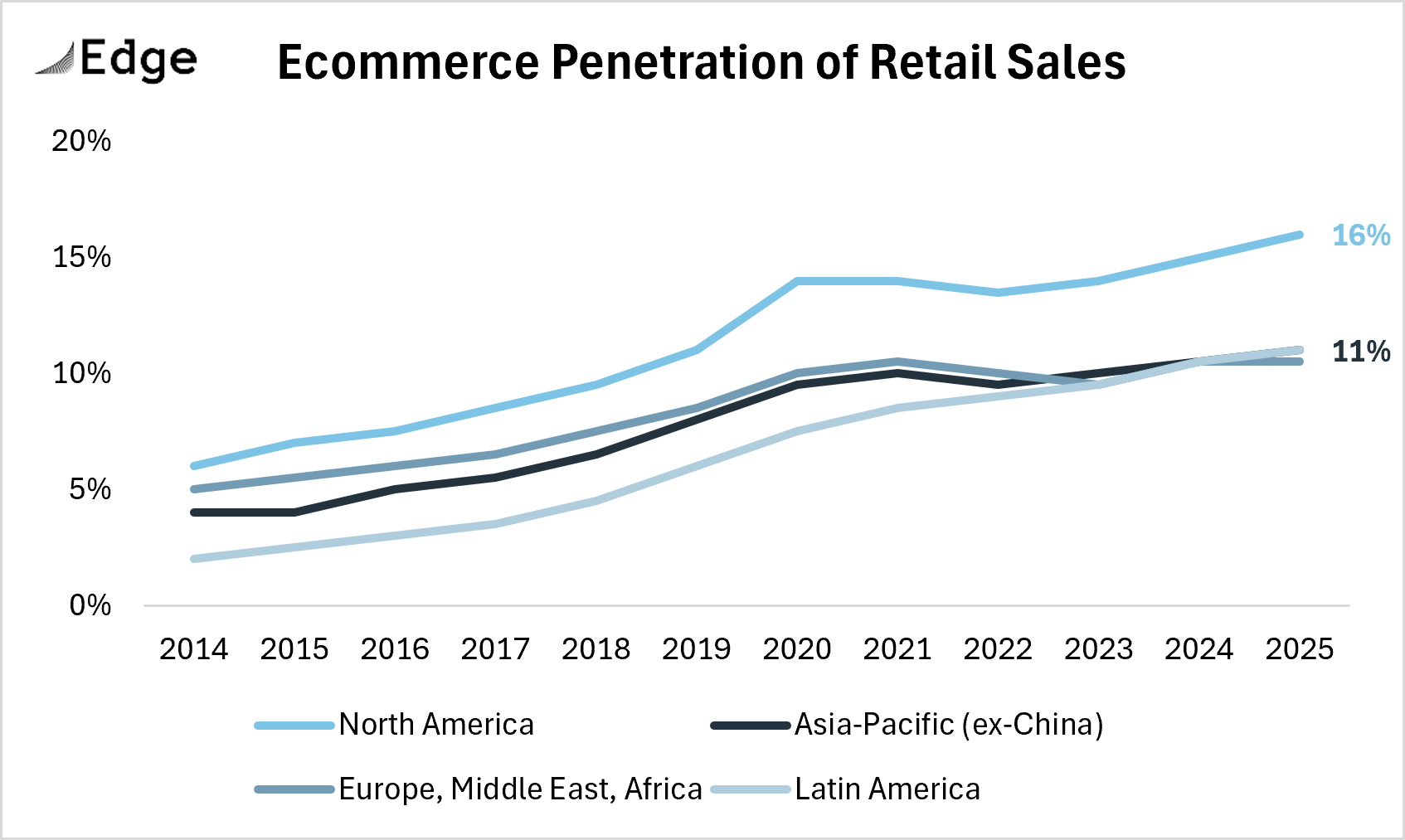
The global retail market is estimated to be USD 31.3tn with an ecommerce penetration of 20.5% (Emarketer, 2025). The market is expected to grow by 3.8% p.a. until 2028 while ecommerce has structurally higher growth of 7.1% driven by increasing penetration rates. The increasing penetration is primarily driven by the globe’s catch-up to Chinese penetration rate; the world’s ecommerce penetration excluding China is 12.8% vs. 51.5% penetration in China (Emarketer, 2025).
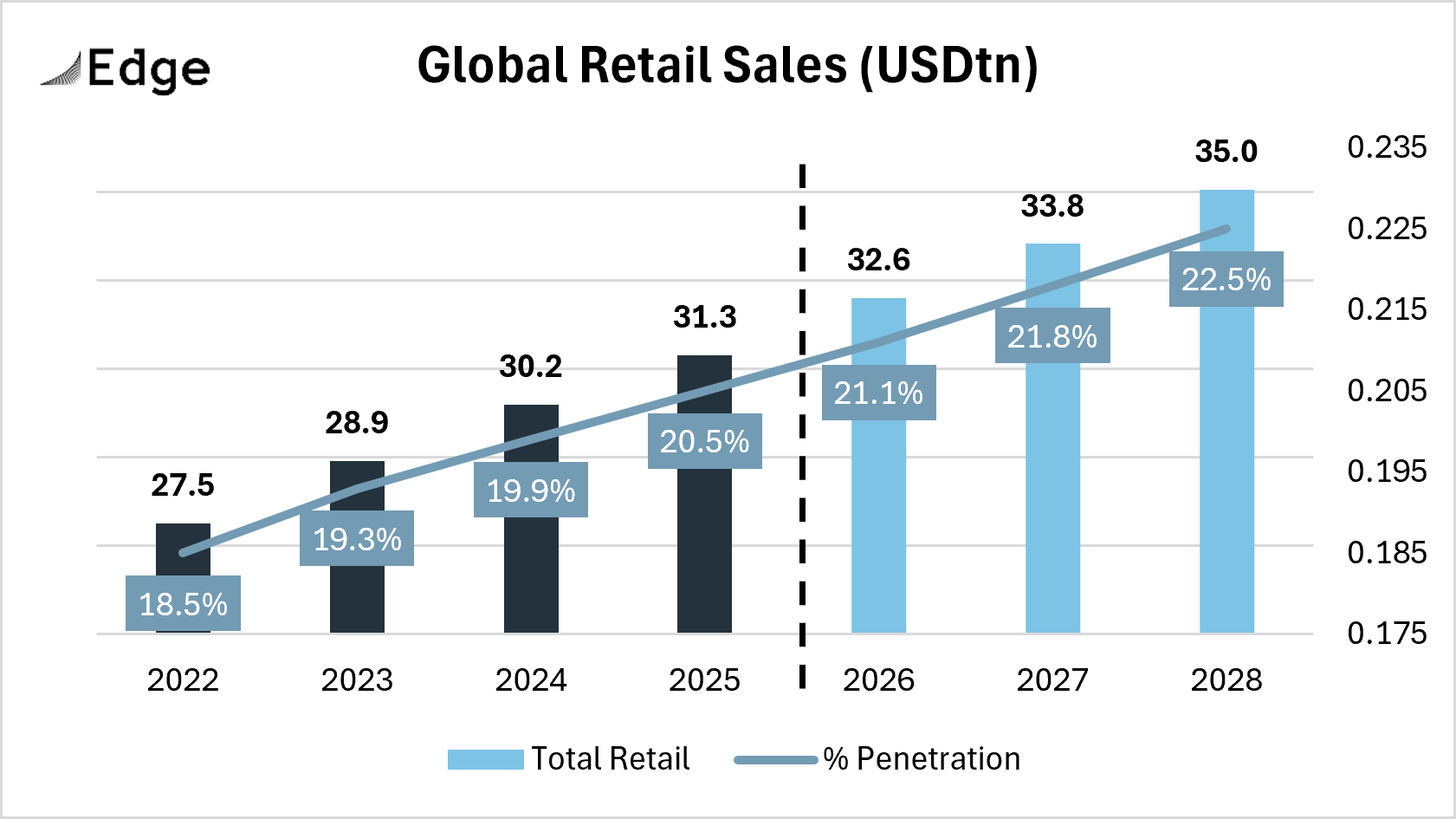
Shopify “had millions of merchants from more than 175 countries using (the) platform“ in 2025. Shopify’s Gross Merchandise Value (GMV) - the combined value of all goods and services sold through merchants on the platform - amounted to USD 378bn. This implies a market share of 1.2% on the world’s entire retail value. Assuming offline GMV at 12% in line with UBS, Shopify’s market share of global ecommerce sales amounts to 5.2% (Yahoo Finance, 2026).
Putting it into perspective, Amazon generated own product sales of ~300bn in 2025. Third-party GMV is not known, but the revenue Amazon generated from referral fees and fulfillment was another ~175bn, hinting to a substantially larger GMV. Overall, Shopify has not yet reached the scale of Amazon, but it becomes competitive. Amazon is the largest US ecommerce player with an estimated market share of ~40% while the combined merchants on Shopify come in second with a reported 14% as per 2025 (FT Partners, 2021). Shopify isn't fighting Amazon for the same merchant. It's collecting the ones Amazon was never going to get, brands with high brand equity and cultural relevance. Canada Goose doesn't sell on Amazon. It sells on Shopify.
Competitive Environment
Website Builder
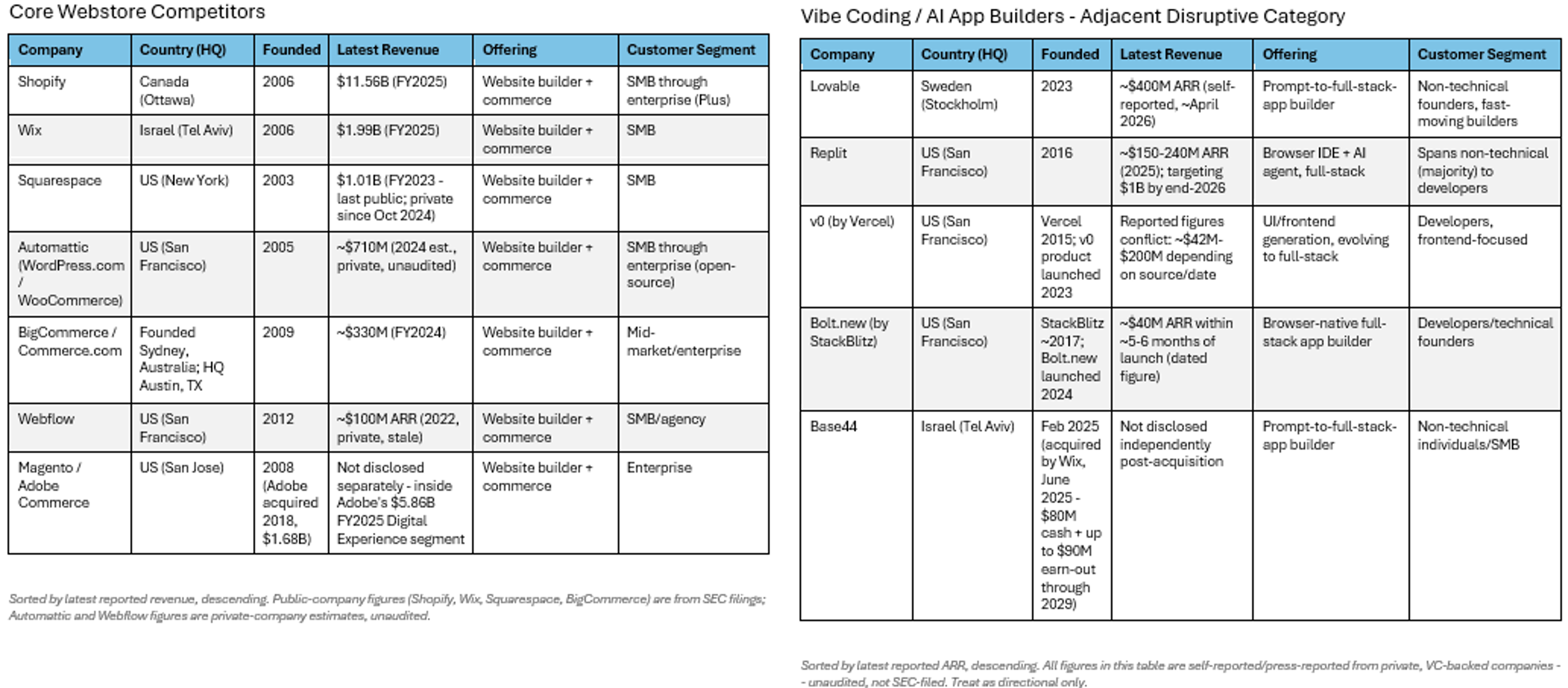
Shopify operates in a highly competitive environment. Below is an overview of core webstore players and vibe coding applications. However, Shopify was able to emerge as one of the clear leaders. Not all information is publicly available and thus relies upon estimates by Claude.
Looking into the market dynamic, it becomes clear that Shopify is the preferred solution. Shopify and Shopify Plus command a ~25% share of websites with checkout usage, the largest and growing share as per BuiltWith. Cart Functionality (CF) is a catch it all phrase that bundles websites with check-out capabilities but without a recognizable ecommerce platform. Hence, not a distinct solution threatening Shopify’s market position. Competitors like Squarespace and Wix are tracked to be roughly the size of WeltPixel, thus, a low penetrated solution (BuiltWith, 2026). The closest household names in website building aren't even competing in the same weight class.
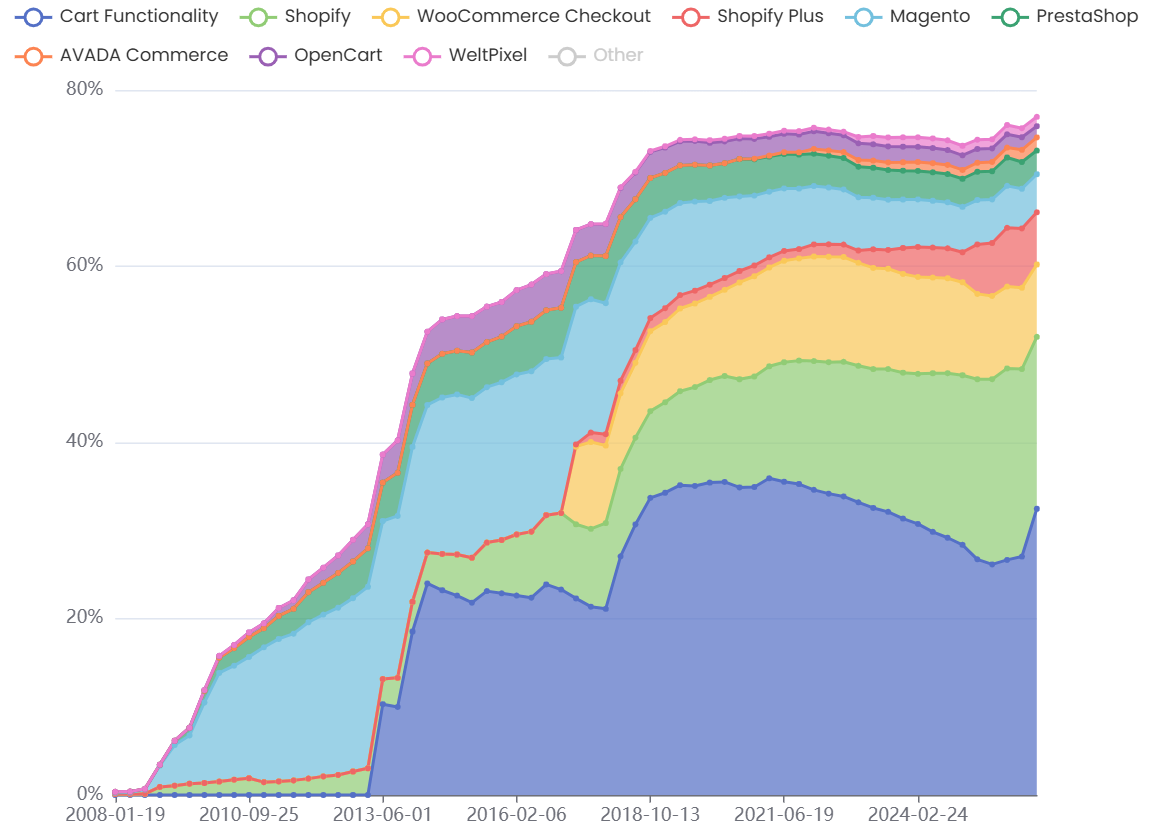
According to the rule of three (Sheth and Sisodia, 2002), most industries are dominated by a market leader (40%-50% market share), a challenger (20%-25%) and a niche player (10%). The ecommerce builder industry is not yet in a mature phase, where share taking is still taking place. Based on the last decade of market dynamics, Shopify seems to emerge as the leader, but has plenty of runway to penetrate the market. Magento and CF are a major source for Shopify’s growth and other smaller and independent solutions will likely face an uphill battle to compete against the behemoth.
Management
Shopify is an owner-operator company. Founded by Tobias Lütke in 2006, he remains CEO and controls the largest block of voting rights.
Tobias “Tobi“ Lütke — Founder and CEO
Lütke trained as a programmer in Germany through an apprenticeship at Siemens, then moved to Canada in 2003, and has served on the core team of the Ruby on Rails framework and built open-source libraries including Active Merchant (Business of Software, 2011). In 2004, living in Ottawa, he started an online snowboard shop called Snowdevil, wrote his own ecommerce software for it because he disliked what was available at the time, ended up prouder of the software than the store itself, and shut Snowdevil down by spring 2005 to build that software into a standalone business, which launched publicly as Shopify in 2006 (NPR, 2019). After having the role of CTO, Lütke became CEO in 2008.
Tobi holds ~79.3m shares, 6.1% of the issued shares and controls ~40% of the votes as per May 2026. His stake is worth USD ~10bn. Some screens often show his ownership as 0.13% of listed Class A shares outstanding which is correct but misses non-traded Class B voting shares and a Founder Share. Class B shares can be converted into Class A shares, the difference is in the voting power. A shares carry 1 vote whereas Bs carry 10 votes. With Tobi holding the majority of his shares as Class B - 99.59% of the entire class - his voting power amounts to ~39%. However, the one Founder Share provides him with at least 40% and up to 49.9% of the entire voting power to ensure sufficient influence even after dilution (Shopify, 2026).
Tobi’s base salary amounts to CAD 1 topped up with equity and option awards. Under Shopify’s "boxcar" model, each executive gets a new equity grant every year, but each grant sits on its own multi-year cliff stacked behind the prior year's grant, so awards never overlap and there's always a large unvested balance ahead of the executive. Vesting is purely a function of time and continued employment — no financial metric or milestone triggers it. As the stock price increases, so does the value of the shares or options underlying the awards. Tobi has a four year cliff, meaning his USD 35m option award starts vesting in February 2029 over the following year at 12 months intervals (Shopify, 2026).
Harley Finkelstein — President
Finkelstein was one of Shopify’s earliest merchants after meeting Lütke in 2009, joined the company in 2010, worked up through COO, and was named President in a September 2020 leadership reshuffle — the same reshuffle in which Lütke took direct control of product (The Globe and Mail, 2020). He “oversees Shopify’s partnerships, brand and external affairs teams” meaning he’s the public face and deal-maker (Shopify Annual Report, 2025). Before Shopify, he trained as a lawyer and had already founded several small companies, going back to a T-shirt business he started as a teenager (The Globe and Mail, 2020).
Finkelstein’s base salary amounts to USD 1m and is topped up with awards worth totalling USD 6.5m. His ownership of the company encompasses 508k shares, 0.04% of all outstanding shares (Shopify, 2026).
CFO and COO
Jeff Hoffmeister (CFO) and Jessica Hertz (COO) both receive a salary of USD 1m which was topped up by USD 9.5m and USD 11m in equity and stock awards to Hoffmeister and Hertz respectively.
Hoffmeister owns 369k shares (0.03% of total outstanding) and Hertz owns 227k shares (0.02%).
Why Did The Stock Sell Off?
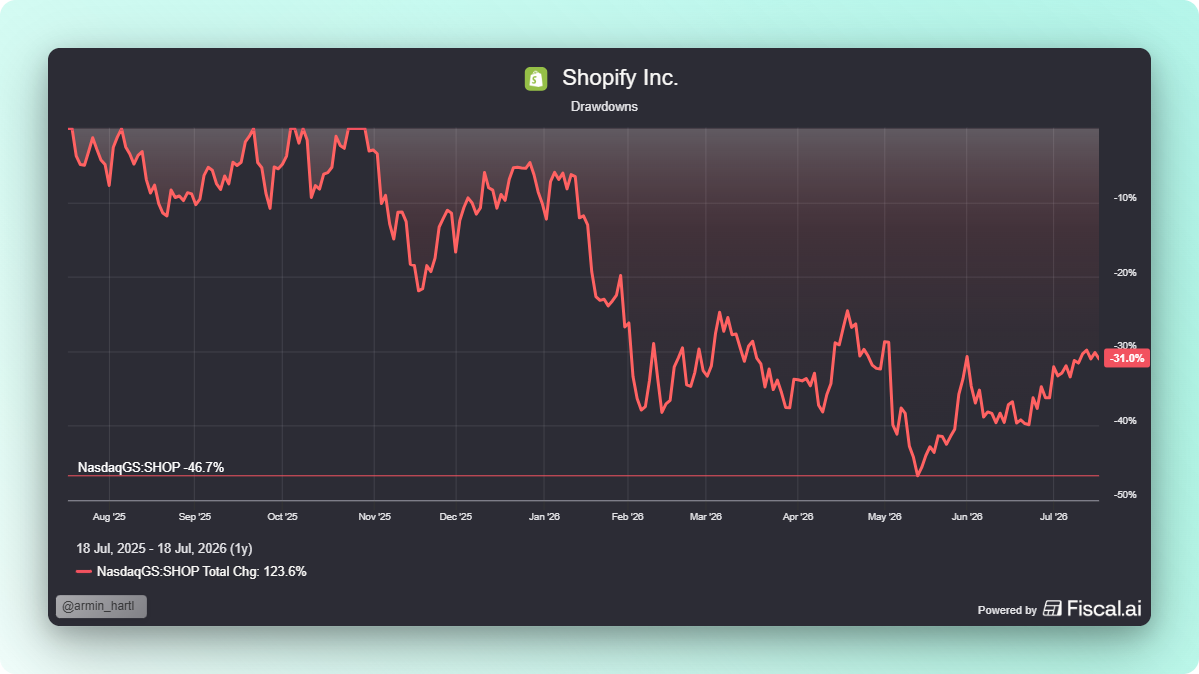
Last year was no fun for Shopify shareholders. After reaching its all-time-high of USD 179/share in October 2025, the stock sold off by as much as 47%. Since the low in May, the shares rebounded but are still in a 31% drawdown. Main concerns involve:
Profitability: Q1 net income was 14% below expectations and mid-teens free cashflow margins was slightly below Wall Street’s expectations
Demanding valuation: Shopify historically trades at a rich valuation, a rerating to it’s higher range of FCF yield over the last 5 years
AI displacement: Shopify was caught in a broad software selloff caused by fears that AI poses an existential threat to the company
Shopify is a category winner with real staying power, and that's the lens the recent sell-off deserves. A profitability miss driven by spending on growth and product improvements isn't a sign the business is breaking down, it's the cost of building a larger, more profitable company in the future. We welcome the decision. AI displacement fears are a different matter, though: the concern isn't this quarter's spending, it's whether demand holds up over the next decade.
Two AI fears are behind the sell-off. The first is "vibe coding": a merchant describes a store to an AI coding tool and gets a working website back, skipping Shopify's paid platform entirely. It's true that AI coding tools make it cheaper and easier to spin up a competing storefront. But building the code is only the starting point. Turning that code into a product that's actually competitive, flexible enough to grow with the business, and then marketing it to customers still takes real experience, not just a few lines of AI-generated code. Forrester examined AI-generated commerce code in March 2026 and found it "may function but falls far short of being production-ready," since payments, fraud detection, tax compliance, and peak-load reliability are the parts a merchant still can't get from a prompt (Shopify, 2026). That's the same infrastructure layer Shopify sells.
The second fear is that AI chat interfaces take over shopping discovery, and OpenAI, Google, or Microsoft capture more of the transaction as a result, shrinking Shopify’s take rate. A chatbot can help someone decide what to buy, but it doesn’t hold inventory, process a payment, calculate tax, or ship a package. Those functions still sit with the merchant and the platform underneath it. The fear that agents cut Shopify out is nonsense: Shopify is the infrastructure layer running the website and the backend behind it, and it already has agentic commerce deals in place. Under its Instant Checkout integration with ChatGPT, the merchant stays merchant of record, the order flows through Shopify’s own systems, and Shopify still collects its usual fee on the sale, regardless of whether the customer arrived via a website or a chat window (Shopify, 2025). Since then, Shopify struck agreements with Microsoft Copilot and Google AI Mode/Gemini (Shopify, 2026).
Moat
Shopify is more robust than the AI related fears make it appear. It operates a flywheel of interlocking competitive advantages which reinforce each other and prove highly resilient.
Economies of scale
Famed by legendary investor Nick Sleep, scale economies shared is a powerful business model responsible for enduring competitive advantages of, among others, Amazon and Costco. Shopify operates in a remarkably similar way, but with a software-driven twist that gives its flywheel a structurally higher margin than a physical retail operation can reach. Here is the exact mechanism: